SIMPLIFYING EXPRESSIONS WITH NEGATIVE EXPONENTS
Subscribe to our ▶️ YouTube channel 🔴 for the latest videos, updates, and tips.
To understand negative exponents, first let us see quotient rule.
To get rid of the negative exponent, we have to flip the base.
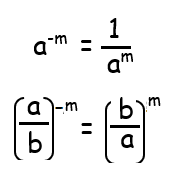
Evaluate the following without using calculator.
Example 1 :
5-2
Solution :
To change the negative exponent, we will flip the base. Here 5 is the base, it is a integer. We can consider 5 as 5/1.
When we flip 5/1, we get 1/5.
|
5-2 = 1/52 = 1/(5 ⋅ 5) = 1/25 |
Flip the base 52 = 5 ⋅ 5 ==> 25 |
Example 2 :
25-1/2
Solution :
To change the negative exponent, we will flip the base.
|
25-1/2 = 1/251/2 = 1/√25 = 1/√(5 ⋅ 5) = 1/5 |
Flip the base Write power 1/2 as square root √25 = √(5 ⋅ 5) = 5 |
Example 3 :
(16/25)-3/2
Solution :
Here the base is a fraction, to get rid of the negative exponent, we will flip the base.
The reciprocal of 16/25 is 25/16.
|
= (25/16)3/2 = [(5/4)2]3/2 = (5/4)2x3/2 = (5/4)3 = 125/64 |
Flip the base Writing 25 and 16 in exponential form Two values in power, so multiply it. Doing simplification, we get |
Example 4 :
(4y)-2
Solution :
|
(4y)-2 = 1/(4y)2 = 1/42y2 = 1/16y2 |
The base is 4y. when we flip the base, we will get By distributing the power, we get |
Example 5 :
(27b)1/3 / (9b)-1/2
Solution :
= (27b)1/3 / (9b)-1/2
= (27b)1/3 ⋅ (9b)1/2
27 = 3 ⋅ 3 ⋅ 3 ==> 33 and 9 = 3 ⋅ 3 ==> 32
= (33b)1/3 ⋅ (32b)1/2
= 3b1/3 ⋅ 3b1/2
= 9 b(1/3 + 1/2)
= 9 b5/6
Example 6 :
b-1/2 = 4, what is the value of b ?
Solution :
b-1/2 = 4
(1/b)1/2 = 4
To get rid of the exponent 1/2, we take squares on both sides.
((1/b)1/2)2 = 42
1/b = 16
Take the reciprocal on both sides, we get
b = 1/16
Example 7 :
(2m)-6 = 16, what is the value of 23 x m ?
Solution :
(2m)-6 = 16
Here 2m is the base, when we flip it
2-6m = 24
Since the bases are equal, we can equate the powers.
-6m = 4
m = -2/3
23 x m = 8 x (2/3)
= 16/3
Example 8 :
If 4n = 20, then what is the value of 4-n ?
Solution :
4n = 20
Take the reciprocal on both sides
1/4n = 1/20
4-n = 1/20
Example 9 :
If a-1/2 = 3, what is the value of a ?
Solution :
a-1/2 = 3
Taking squares on both sides, we get
(a-1/2)2 = 32
a-1 = 9
1/a = 9
a = 1/9
Example 10 :
If 3x = 10, what is the value of 3x-3 ?
Solution :
Given :
3x = 10
3x-3 = 3x ⋅ 3-3
= 10 ⋅ 3-3
= 10/33
= 10/27
Example 11 :
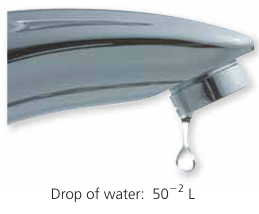
A drop of water leaks from a faucet every second. How many liters of water leak from the faucet in 1 hour?
Solution :
1 hour = 60 minutes
1 minute = 60 seconds
1 hour = 60 x 60 ==> 3600 seconds
Water leaks from the faucet at a rate of 50−2 liter per second. Multiply the time by the rate.
= 3600 x 50−2
= 3600 x (1/502)
= 3600/2500
= 1.44
So, 1.44 liters of water leak from the faucet in 1 hour.
Example 12 :
a) If a is a nonzero number, does the value of a0 depend on the value of a?
b) Explain how to evaluate 10−3
c) Without evaluating, order 50, 54, and 5−5 from least to greatest.
Solution :
a) No, becaause anything to the power of 0 will given the result 1.
b) To evaluate the value 10−3, we should change the negative exponent as positive.
10−3 = 1/103
= 1/(10 x 10 x 10)
= 1/1000
c) Without evaluating, order 50, 54, and 5−5 from least to greatest.
Anything to the power 0 will give the result 1.
To convert the negative exponent as positive exponent, we have write the reciprocal of the given fraction.
By considering all these points, we know that the least value is 5−5. By arranging from least to greatest, we get
5−5, 54, 50
Example 13 :
Which is different? Find “both” answers.
a) Rewrite 1/(3 ⋅ 3 ⋅ 3) using a negative exponent.
b) Write 3 to the negative third power.
c) Write 1/3 cubed as a power.
d) Write (−3) ⋅ (−3) ⋅ (−3) as a power.
Solution :
a) 1/(3 ⋅ 3 ⋅ 3) = 1/33
b) 3 to the negative third power = 3-3
to convert the negative exponent as positive exponent, we get 1/33
c) 1/3 cubed as a power = (1/3)3 ==> 1/33
d) (−3) ⋅ (−3) ⋅ (−3)
Since the same number is repeating three times, we use exponential form to write it,Then we get
= (-3)3
From the analysis above, statements (a), (b) and (c) are the same and (d) is different.
Example 14 :
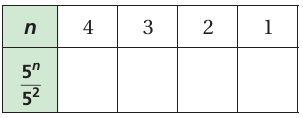
Use the Quotient of Powers Property to copy and complete the table.
a) What patterns do you see?
b) How would you define 50? Why?
c) How can you rewrite 5−1 as a fraction?
Solution :
5n/52 = 5n - 2
|
When n = 4 = 54 - 2 = 52 = 25 |
When n = 3 = 53 - 2 = 51 = 5 |
When n = 2 = 52 - 2 = 50 = 1 |
When n = 1 = 51 - 2 = 5-1 = 1/5 |
a) To get the next value, we have to divide the preceeding value by 5.
b) The value of 50 is 1.
c) 5-1 = 1/5
Example 15 :
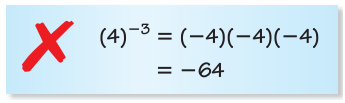
Describe and correct the error in evaluating the expression.
Solution :
Since we have negative exponent, by converting into the reciprocal only we can change the negative exponent to positive exponent.
4-3 = 1/43
= 1/(4 x 4 x 4)
= 1/64
Subscribe to our ▶️ YouTube channel 🔴 for the latest videos, updates, and tips.
Recent Articles


-
Finding Range of Values Inequality Problems
May 21, 24 08:51 PM
Finding Range of Values Inequality Problems -
Solving Two Step Inequality Word Problems
May 21, 24 08:51 AM
Solving Two Step Inequality Word Problems -
Exponential Function Context and Data Modeling
May 20, 24 10:45 PM
Exponential Function Context and Data Modeling