GRAPHING ABSOLUTE VALUE FUNCTIONS
Subscribe to our ▶️ YouTube channel 🔴 for the latest videos, updates, and tips.
To graph absolute value function, we have to find the following characteristics of the given function.
(i) Find vertex
(ii) x - intercepts (roots, zeroes, solutions) and y - intercept
(iii) Slope and Reflections (or) Direction of opening
(iv) Domain and Range
(v) Increasing/decreasing interval
Finding Vertex of Absolute Value Functions
To find the vertex of absolute value function, we have to compare the given function with vertex form
y = a|x - h| + k
Here (h, k) is vertex.
For example,
y = 2|x + 1| - 3
To find vertex of the function above, we compare with vertex form.
y = 2|x - (-1)| - 3
Vertex is at (-1, -3).
x and y intercepts
To find x - intercept, we will apply y = 0. For example,
y = 2|x + 1| - 3
x-intercept :
Put y = 0
0 = 2|x + 1| - 3
2|x + 1| = 3
|x + 1| = 3/2
|
x + 1 = 3/2 x = 3/2 - 1 x = 1/2 |
-(x + 1) = 3/2 x + 1 = -3/2 x = -3/2 - 1 x = -5/2 |
x-intercepts are (1/2, 0) and (-5/2, 0)
y-intercept :
Put x = 0
y = 2|0 + 1| - 3
y = 2 - 3
y = -1
y-intercept is at (0, -1).
Subscribe to our ▶️ YouTube channel 🔴 for the latest videos, updates, and tips.
Slope and Reflections
(or) Direction of Opening
The function which is in the form
y = a|x - h| + k
a is slope and the sign of a will decide the reflections.
- If a is positive, the curve will open up.
- If a is negative, the curve will open down.
For example,
y = 2|x + 1| - 3
Slope = 2, since the sign of a is positive, the curve will open up.
Domain and Range
All possible inputs is known as domain.
For those inputs, the set of values what we are receiving is range.
For example,
y = 2|x + 1| - 3
All real values is domain. Range is (3, ∞).
Increasing and Decreasing Interval
If the curve opens up,
- to the left of minimum, it is decreasing
- to the right of minimum, it is increasing.
If the curve open down,
- to the left of maximum, it is increasing.
- to the right of maximum, it is decreasing.
Graph the following absolute value function :
by finding the following.
(i) Vertex
(ii) Slope
(iii) Direction of opening
(iv) x and y intercepts
(v) Domain and range
(vi) Increasing and decreasing
Problem 1 :
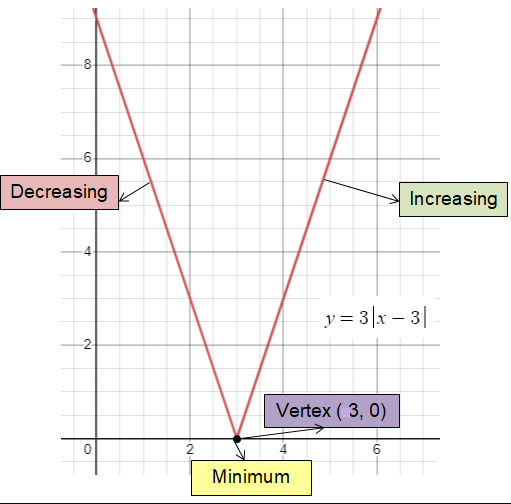
y = 3|x - 3|
Solution :
Finding vertex :
y = 3|x - 3|
Comparing with y = a|x - h| + k
y = 3|x - 3| + 0
Vertex is at (3, 0).
x and y-intercepts :
x-intercept, put y = 0
3|x - 3| = 0
Since we have zero on the right side, don't have to decompose it into two branches.
|x - 3| = 0
x = 3
x-intercept is (3, 0).
y-intercept, put x = 0
y = 3|0 - 3|
y = 3(3)
y = 9
y-intercept is at (0, 9).
Slope :
a = 3
The curve will open up.
Domain and range :
- All real values is domain.
- Range is 3 ≤ y ≤ ∞
Increasing and Decreasing :
- To the left of minimum, it is decreasing.
- To the right of minimum, it is increasing.
Recent Articles


-
Finding Range of Values Inequality Problems
May 21, 24 08:51 PM
Finding Range of Values Inequality Problems -
Solving Two Step Inequality Word Problems
May 21, 24 08:51 AM
Solving Two Step Inequality Word Problems -
Exponential Function Context and Data Modeling
May 20, 24 10:45 PM
Exponential Function Context and Data Modeling